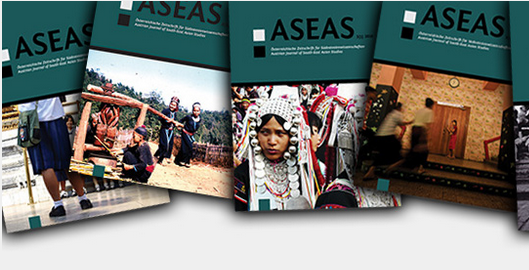
The upcoming issue 6(2) of the Austrian Journal of South-East Asian Studies (ASEAS) will feature a focus on Mobilities in South-East Asia, and aims at bringing together researchers from various academic fields in order to do justice to the interdisciplinary nature of this broad topic. The notion of Mobilities, in the broader sense, refers to movements (or non-movements) of persons, objects, information, or capital over time and space. Studies on Mobilities can bridge the fields of migration and tourism; two disciplines that frequently find themselves joined under the umbrella term Mobilities. Thereby, more specifically, an emphasis is put on the movement of people between, across, and within national boundaries. While a theoretical debate on these topics is necessary to contribute to the understanding of Mobilities in its different facets, methodological contributions prove beneficial for advancements in this fundamental area of research. If you intend to submit a paper, please contact the editorial board (aseas@seas.at), as this facilitates our planning process. Submissions dealing with one or several of the following issues are of special interest to the board of editors:
- Theoretical debates on mobilities and conceptual challenges resulting from empirical research, e.g. discussing agency-structure approaches
- Methodological contributions to the field: ‘mobile’ and dynamic methods to understand migration, tourism, and mobilities in the 21st century
- Intersections of tourism and migration, e.g. international retirement migration or migration into tourist spaces
- Subnational forms of mobilities such as rural-urban, urban-urban, or rural-rural migrations
- Forced migration, e.g. people having to leave their homes due to conflict, environmental degradation etc.
- Transnational lives of South-East Asian communities abroad
- Emotion and mobility, focusing on emotional issues such as love, sex, and aff ection in the context of migration decision making and migrant agency
- Upward and downward social mobilities, change of socioeconomic status through migration
- (Im)mobility, exclusion, and inequality: barriers to movement and broader aspects of society and mobility, e.g. the role of the ‘left-behind’ in migration processes
- Mobilities of tourism and travel: movement of tourists and its implications, attempts to understand the post-modern subject on the move, interactions in tourism
- Tourism for sustainable development: alternative forms of tourism, tourism and empowerment, sustainable mobilities
- Rethinking place and space in mobility studies: the meaning of place and space for the investigation of tourism, migration, and communities (e.g. community-based tourism, the importance of ‘community’ in tourism)
- As always, book reviews and suggestions for interviews are welcome (for further details, please contact the board of editors)
Authors can however reach the board of editors by the usual email address aseas@seas.at
Find more info on www.seas.at/aseas
DESCRIPTION: The Austrian Journal of South-East Asian Studies (ASEAS) is a core project of the Society for South-East Asian Studies (SEAS) in Vienna. The journal’s editors invite both established as well as young scholars to present research results and theoretical papers (scientific and journalistic texts are welcome), to report about ongoing research projects or field studies, to introduce academic as well as non-academic institutions, to publish conference reports and other short essays, to conduct interviews with experts on South-East Asia, or to review literature. Articles have to be written in German or English. As an interdisciplinary journal, ASEAS intends to cover a variety of aspects of South-East Asia (archaeology, culture, economics, geography, linguistics, politics, society, etc.) from both historical as well as contemporary perspectives. Topics should be related to South-East Asia, but they do not need to be restricted to the geographical region, as in the case of – for example – linguistics, diaspora groups, forms of socio-cultural transfers, and so forth, where spatial and political borders of South-East Asia are crossed. ASEAS is published biannually both in print and as an online Open Access-Journal. The print version is intended for universities, research institutions, public libraries, and so forth, which wish to include ASEAS into their archives. The print version can be ordered directly by e-mail from this website. The free-of-charge online Open-Access version is designed to address a wide interested public and international expert readership who are interested in single articles, but do not intend to archive all volumes. Submissions within the category “Aktuelle Südostasienforschung / Current Research on South-East Asia” are subject to a twofold double-blind review process. Submissions within other sections will be reviewed by the editorial board as well as by external reviewers if needed. For more details have a look at our Submission Guidelines.
ASEAS offers 7 different Sections or Categories: Current Research on South-East Asia, Forum South-East Asia, Research Workshop, In Dialogue, Network South-East Asia Research, South-East Asia Visually, Reviews
FIND MORE INFO HERE: www.seas.at/aseas